




























Automating 1k credit checks / day in HubSpot – synced with the ERP
How we helped a financial services firm push live credit data into HubSpot — kept in sync with their ERP every 30 minutes.
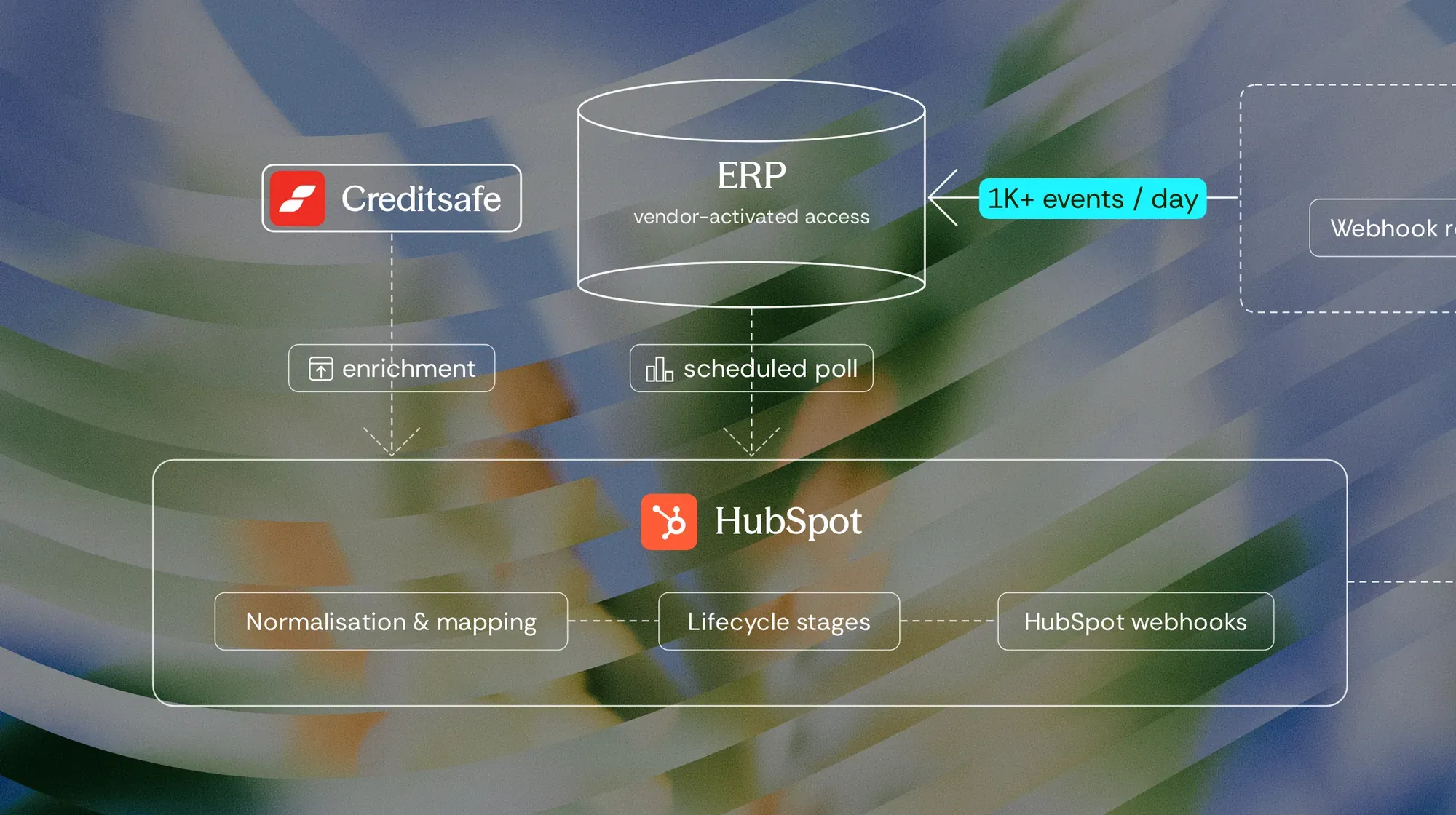
Commercial teams worked in HubSpot.
Finance and delivery worked in an ERP whose integration surface is licensed and activated by the vendor, one customer at a time.
The only supported path into the ERP was the vendor's own plugin, polling HubSpot on a schedule.
That left two gaps:
Step 1: Matching
The plugin pairs records by identifier and by address.
When address formatting drifts in the CRM — and it always does — the match misses and a duplicate record is created downstream.
The plugin isn't ours to modify, so we worked upstream: deterministic unique identifiers on every company record, and a normalized address pattern enforced in HubSpot before the plugin ever sees it.
Field-level mapping was rationalized across both systems, first as a one-off cleanup ahead of the initial sync, then as a standing rule.
Step 2: Enrichment
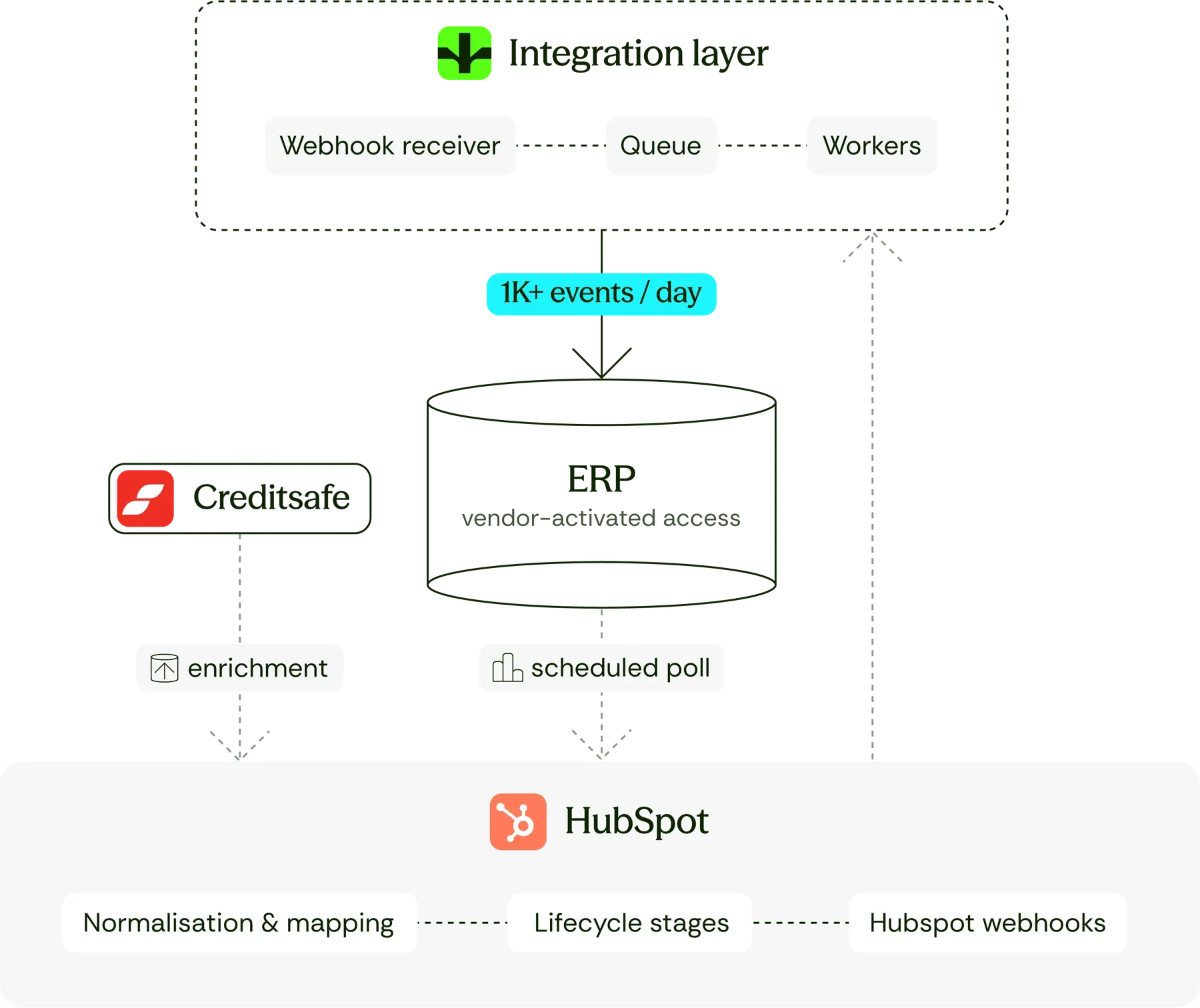
Credit positions from Creditsafe had to reach the ERP at specific points in the customer lifecycle — not in a nightly dump, and not by hand.
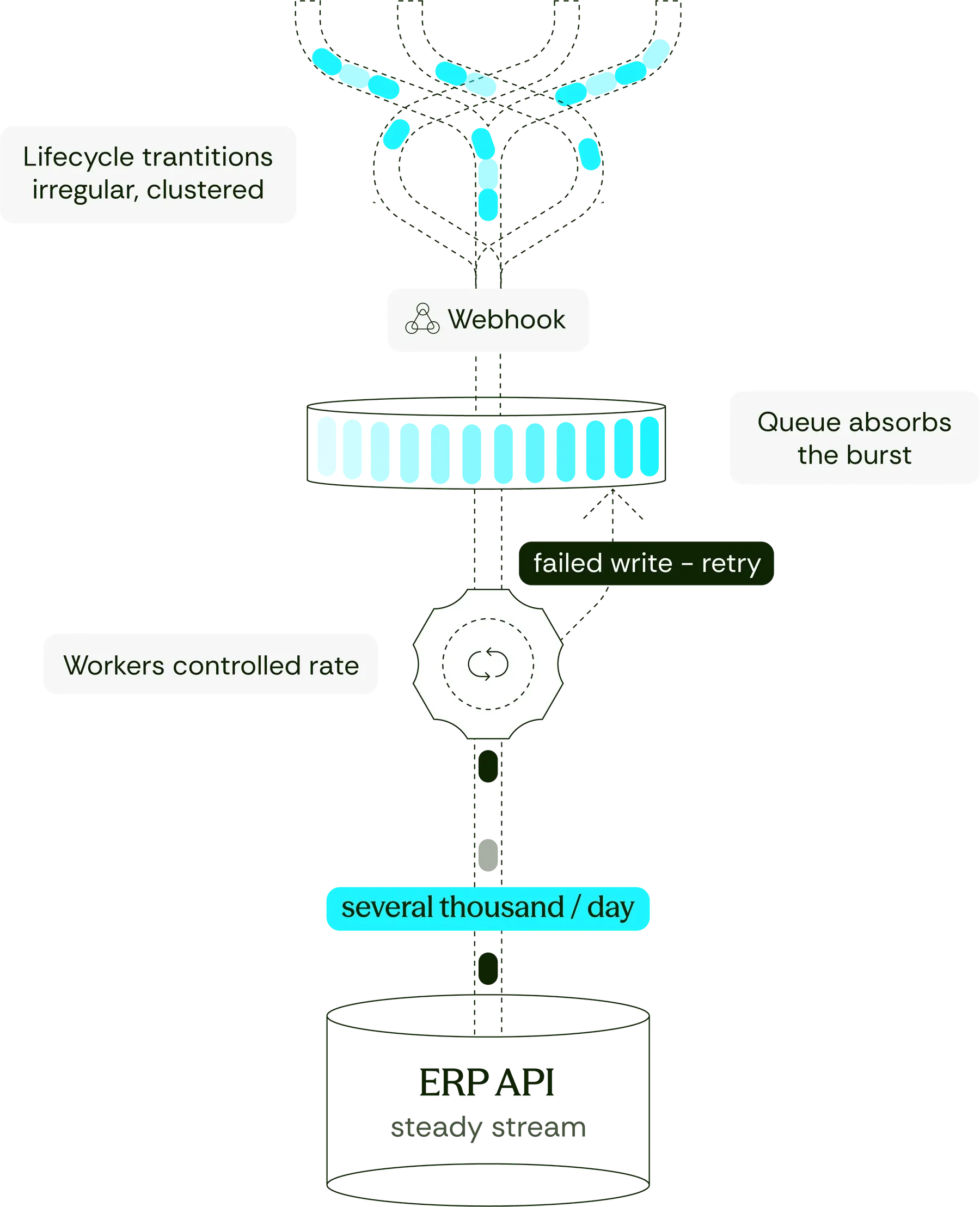
We built an event-driven path: a lifecycle transition in HubSpot fires a webhook, the payload lands in a queue, and workers drain that queue at a rate that stays within the ERP's limits.
At peak the pipeline handles several thousand enrichment writes a day.
The ERP sees a steady stream. It never sees the spike.
Vendor-activated API access
The ERP’s integration surface is licensed and switched on by the vendor, one customer at a time.
Matching owned by the plugin
Not ours to change, so the fix had to happen upstream of whatever reads the records.
Write bursts
A bulk import in the CRM must not arrive at the ERP as a bulk import.
1k credit checks a day, and the ERP never feels the peak.
Credit positions are visible where the commercial team already works, at the moment a decision is being made — not looked up on request, one company at a time.
The ERP holds one record per client instead of a duplicate estate that nobody notices until it reaches the accounts.
Around fifteen hours a month of manual entry and manual lookups stop existing.
Peaks in activity don't overload the ERP, so the commercial team can run bulk imports and list-wide workflows without warning anyone first.



Data problems shaped like this one?
If some of this reads like your situation, say which part. Datsugi replies within 2 business hours, guaranteed (CET).

Arrigo Lupori
Founder & Managing Director